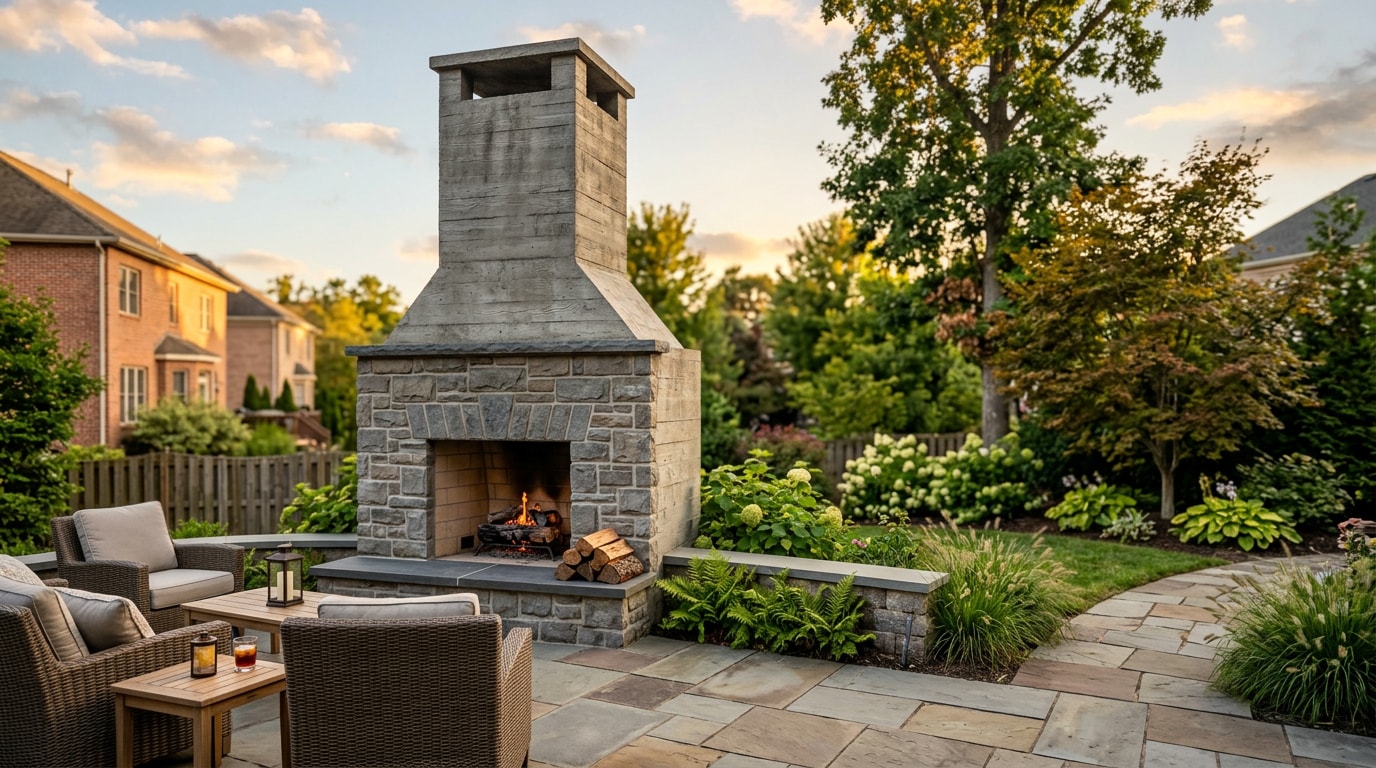
A concrete fireplace in Baltimore County, MD typically runs $3,000 to $15,000 installed, depending on size, finish, and whether it sits indoors or in the backyard. Before you call a contractor, you also need to know whether the county actually requires a permit and whether concrete can outlast stone or brick through a Maryland winter. This guide answers both with real county permit records, not guesswork.
What a Concrete Fireplace Costs in Baltimore County (2026)
Material choice and customization level drive most of the price spread between a basic concrete surround and a fully finished, stamped fireplace with a custom mantel.
Material Costs: Concrete vs. Stone vs. Brick vs. Metal
| Material | Typical cost per sq ft | Why |
|---|---|---|
| Poured/refractory concrete | $6–$12 | Formed and cured on-site; less labor than cut masonry |
| Concrete block | $7–$13 | Standardized units, moderate labor for setting and finishing |
| Manufactured stone veneer | $10–$18 | Lightweight but needs skilled, precise installation |
| Natural stone | $15–$30 | Hand-cut, heavier, and far more labor-intensive to set |
| Brick | $8–$16 | Moderate labor, but mortar joints add time |
| Metal (prefab insert) | $2,500–$6,000 (unit price) | Factory-built, lowest on-site labor |
Concrete tends to land on the lower-to-middle end of that range because poured and block concrete can be formed and finished faster than hand-set natural stone. The real cost gap comes down to labor hours: stone setters charge for precision cutting and fitting, while concrete work scales efficiently once forms are built.
Add-On and Customization Costs
Add-ons shift the final number quickly:
- Veneer facing: $800–$2,500
- Hearth extension: $300–$1,200
- Custom mantel: $500–$3,000
- Chimney work (when needed): $1,500–$5,000
Outdoor concrete fireplaces usually run 10–20% higher than indoor builds because of added weatherproofing and footing requirements. Our crews at EMGE Paving & Roofing see that gap close somewhat when a surround is poured in the same visit as a patio or walkway, since the forms and concrete delivery are already on-site. If you're also planning a patio around the fireplace, our walkway and patio installation crews often bundle both into one mobilization to save on setup costs.
Do You Need a Permit for a Concrete Fireplace in Baltimore County?
This is where a lot of online guides get vague, and it costs homeowners real time later. Baltimore County actually separates "built fireplace" permits from "recreational fire" rules, and they are not the same thing.
Built fireplaces and chimneys: Baltimore County's Department of Permits, Approvals and Inspections states plainly that a permit is required when building a fireplace, wood stove, pellet stove or other burning stove . That applies to a permanent concrete or masonry fireplace whether it's indoors or built into an outdoor living space, regardless of diameter or square footage. The application is processed online, and once it's approved, permits and approved plans must be available at the job site for inspections .
Portable or small recreational fire pits: This is a separate track under the Fire Marshal's open burning rules, not the building permit process. The county allows small recreational fires no larger than three feet in diameter, which can be purchased or self-constructed , without a building permit. At one- and two-family homes, the use of fire pits and chimineas is unrestricted , though fire officials strongly recommend that they be kept at least 15 feet from the home .
A quick checklist before you apply:
- Confirm whether your project is a permanent built structure (permit required) or a portable fire pit (usually exempt).
- Have a rough site plan ready showing distances to structures and property lines.
- Apply online through the county's permitting portal; in-person help is available at the Towson office if needed.
- Keep the approved permit and plans on-site through final inspection.
Baltimore County's current building code also matters here. The most recent edition of the Baltimore County Building Code was enacted by Baltimore County Council Bill Number 49-24, effective September 3, 2024, adopting the 2021 editions of the International Building, Residential, and related codes . Any fireplace permit reviewed today is checked against that 2021-code baseline, not older editions some contractors still reference.
Concrete Fireplace Hearths: Function and Cost
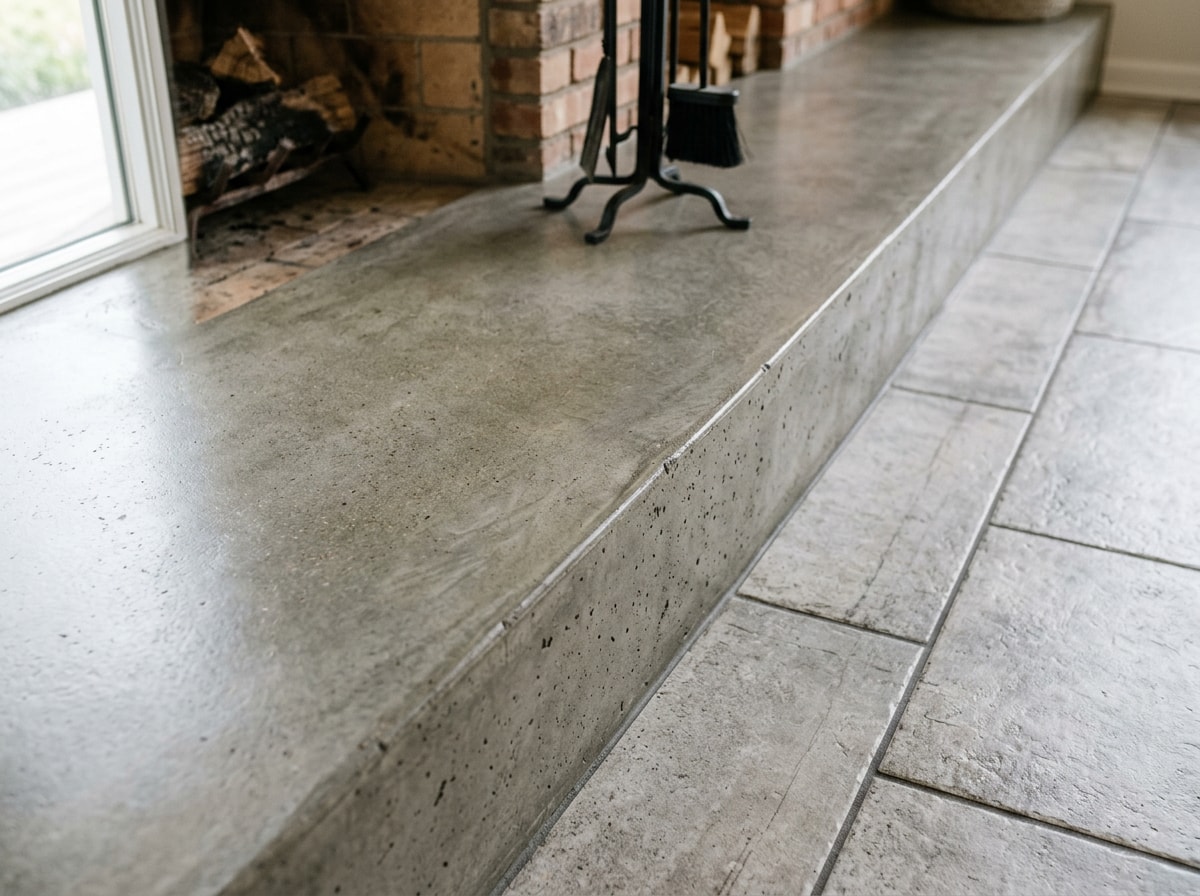
A concrete fireplace hearth is the fire-resistant, load-bearing base that sits beneath or in front of a firebox, protecting the surrounding floor from heat and embers. Concrete is the default here because it handles sustained heat without cracking the way softer materials can.
A concrete hearth typically runs $5–$10 per square foot installed, compared to $8–$15 for slate or tile and $10–$20 for natural stone. Standard structural concrete isn't rated for direct firebox contact, though. Refractory concrete, a high-heat mix built for sustained flame exposure, lines the actual firebox, while standard concrete handles the surround and hearth. According to industry fire-protection guidance, concrete masonry, due to its inherent durability, reliability, and superior fire resistance characteristics, is well suited to a range of fire protection applications when complying with the life safety requirements of contemporary building codes . For hearth and surround options specific to your layout, see our projects page for recent concrete and masonry builds.
Why Concrete Outperforms Stone and Brick in Maryland's Climate
Durability and Low Maintenance
Concrete handles daily wear, moisture, and temperature swings well, and properly installed concrete doesn't get slippery when wet or degrade under sustained heat.
Freeze-thaw cycling is the real durability test in Baltimore County. Water that seeps into unsealed concrete and repeatedly freezes can cause surface flaking over a few winters. On the repair calls we take after a hard Maryland winter, the flaking almost always traces back to a skipped sealing cycle, not a bad concrete mix. Sealing every 2–3 years is the simplest way to avoid that call in the first place.
Home Value and Design Versatility
A well-finished concrete fireplace can boost curb appeal and resale value, especially with a stamped finish. Stamped concrete involves pressing decorative patterns into the surface before it fully cures, a process best left to installers who know how timing and pressure affect the final texture.
Concrete molds into nearly any shape and finish, which gives more design flexibility than brick or pre-formed stone veneer. A custom finish lets a fireplace surround match existing patio or walkway work, tying the whole backyard together. Our hardscape installation team often matches a new fireplace surround to an existing patio pour for exactly this reason.
Installation Process: From Foundation to Finished Hearth
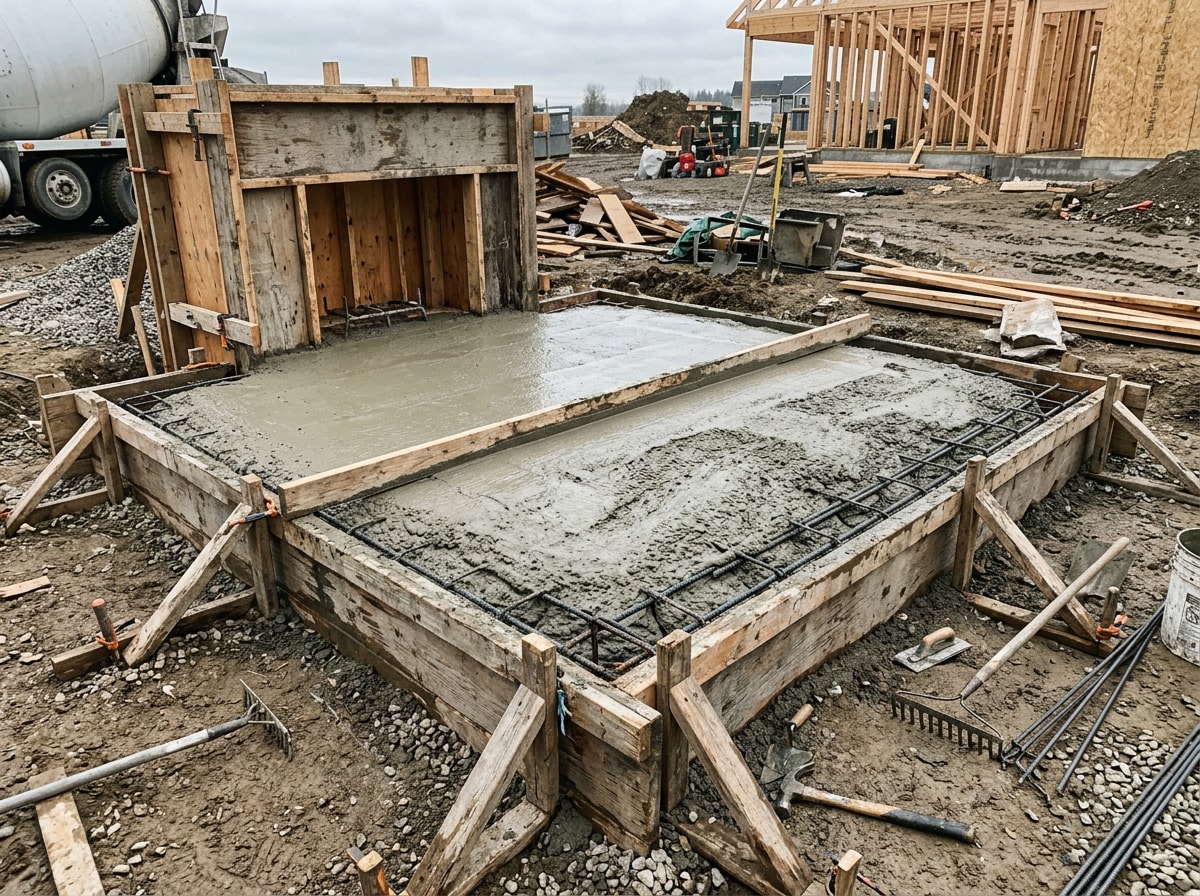
A typical build follows a consistent sequence:
- Site prep and grading — excavate the footprint, check slope and drainage.
- Base compaction — lay and compact crushed stone or a concrete base layer.
- Forming — build forms to the finished dimensions.
- Pour or set — pour concrete or set masonry units, then let the structure cure.
- Finish work — seal, stamp, or veneer once curing is complete.
For a straightforward residential project, expect 1–3 weeks from foundation prep to finished surface, weather permitting. Uneven or sloped yards add time at step one, which is why our site grading and preparation crews usually walk the site before a mantel or veneer gets ordered. If your project also involves anchoring a heavy stone mantel or structural tie-ins, our guide on wedge anchors for concrete covers sizing and load specs for that hardware.
Ready to get a firm number for your property? Get a free estimate from EMGE Paving & Roofing, and we'll walk the site before you commit to a design.
FAQ
Is a Concrete Fireplace Safe and Fireproof?
Standard structural concrete isn't built for direct firebox contact. Refractory concrete, rated for sustained flame exposure, lines the firebox, while standard concrete handles the surround and hearth. Concrete masonry's inherent durability and fire resistance make it well suited to fire protection applications when it complies with current building code life-safety requirements . Confirm the exact mix and code compliance with your contractor before pouring.
Do You Need a Permit to Build a Fireplace in Baltimore County?
Yes. A permit is required when building a fireplace, wood stove, pellet stove or other burning stove in Baltimore County, regardless of whether it's indoors or an outdoor built structure. Apply through the county's online permitting portal before construction starts.
Do You Need a Permit for a Small Outdoor Fire Pit?
Usually not, if it's portable and stays under the size limit. Small recreational fires no larger than three feet in diameter are allowed and can be purchased or self-constructed , and fire pits and chimineas are unrestricted at one- and two-family homes . That exemption applies to portable units, not a permanent poured or masonry fireplace.
Is a Concrete Fireplace Cheaper Than Stone or Brick?
Generally, yes. Concrete typically runs lower than natural stone and comparable to or slightly below brick, mainly due to lower labor intensity. The gap narrows with heavy customization, but concrete usually remains the more budget-friendly base material.
Can You Build a Fireplace Out of Concrete Block?
Yes. Concrete block is a common base for both indoor fireplaces and outdoor fire features, running roughly $7–$13 per square foot installed. It's set faster than hand-cut stone and is typically finished with veneer, stucco, or a stamped overlay for the visible surface.
How Long Does a Concrete Fireplace Last?
A well-built, properly sealed concrete fireplace can last for decades with minimal structural issues. Lifespan depends heavily on sealing frequency and exposure to freeze-thaw cycling, so staying on a 2–3 year sealing schedule is the main factor in how long it actually holds up.
Looking for a contractor who handles both the concrete work and the permit paperwork? Visit EMGE Paving & Roofing or check our Baltimore County service area page to see recent local projects.