Self tapping concrete screws are the fastest way to anchor shelving, conduit, or ledger boards into masonry anywhere in Carroll County, MD, because they cut their own threads and skip the separate anchor sleeve older fasteners require. Get the diameter, pilot hole size, or embedment depth wrong, though, and the screw strips out, cracks the block, or backs out under load. This guide covers sizing, tools, and the exact installation sequence, plus a code detail most buying guides leave out entirely.
What Are Self-Tapping Concrete Screws?
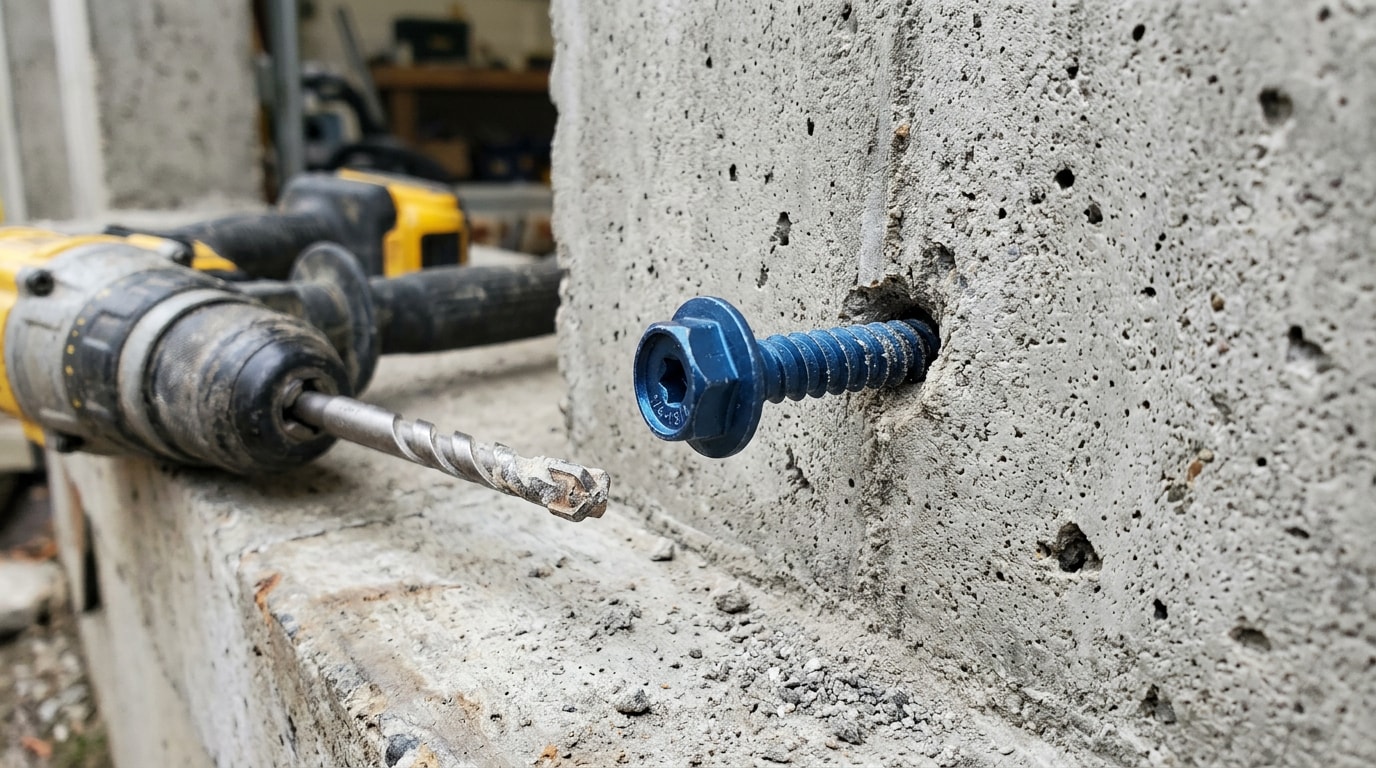
Self-tapping concrete screws cut their own threads directly into a pre-drilled hole, which means you skip the separate anchor or sleeve that older fastening methods required. The design of these concrete masonry screw anchors allows for anchoring into concrete, brick and block, tapping threads into a predrilled hole in masonry materials. Most people know them by the brand name Tapcon, though "masonry screws" and "concrete anchors" get used interchangeably at the hardware store. They're not the same as self-drilling screws, which bore their own hole in metal — concrete screws still need a pilot hole drilled first.
Our crews work masonry fastening into paving, hardscape, and repair jobs across Carroll County and the surrounding Maryland counties every month, and the single biggest cause of callbacks is a mismatched bit size, not a bad screw.
Base Materials Suitable for Concrete Screws
These screws work in poured concrete, brick, concrete block (CMU), and mortar joints, though each material behaves a little differently. As a rule of thumb, harder cured concrete needs less embedment to reach full holding value than softer block, but always check the manufacturer's published table for the specific material you're fastening into. Mortar joints can work in a pinch, but they're weaker than the surrounding masonry units and shouldn't carry heavy structural loads. If you're planning a heavier structural connection, like a bolted railing or ledger board, compare this guide against our wedge anchors for concrete in Carroll County guide before you buy.
Choosing the Right Concrete Screw for Your Project
Picking the right concrete screw comes down to four variables working together: diameter, length, embedment depth, and head style. Get one wrong and the fastener either strips out or doesn't sit flush.
Concrete Screw Sizes & Diameters
The two standard diameters for residential and light commercial work are 3/16 inch and 1/4 inch. The 3/16" diameter comes in a 5/32" drill bit with 1"/1-3/4" minimum embedment in lengths from 1-1/4" to 4", while the 1/4" diameter uses a 3/16" bit with the same embedment range in lengths up to 6".
| Diameter | Pilot Hole Bit | Min / Max Embedment | Typical Length Range |
|---|---|---|---|
| 3/16 in | 5/32 in carbide | 1 in / 1¾ in | 1¼ in – 4 in |
| 1/4 in | 3/16 in carbide | 1 in / 1¾ in | 1¼ in – 6 in |
The 3/16 inch screw suits lighter-duty attachments — electrical boxes, trim, small brackets. The 1/4 inch screw handles heavier loads like ledger boards or structural brackets. Large-diameter 3/8-inch and 1/2-inch Tapcon+ style screw anchors also exist for cracked and uncracked concrete, resisting static, wind, and seismic tension and shear loads , but those fall into a separate heavy-duty, engineered-anchor category rather than standard light-duty self-tapping screws.
Head Styles: Hex Washer vs. Flat Phillips
Flat head Phillips screws countersink flush with the material surface, which makes them the right call for cabinetry, door frames, or anything where a protruding head would get in the way. Hex washer head screws sit proud of the surface and are driven with a nut driver or socket, making them better suited to surface-mounted items like conduit straps, electrical boxes, or metal brackets. If appearance matters and the item needs to sit tight against the wall, go countersunk. If you need faster driving and easy removal for maintenance, hex washer head wins.
Screw Length & Embedment Range
A 1/4-inch screw needs a 3/16-inch pilot hole, with a 1-inch minimum and 1-3/4-inch maximum embedment. Going deeper than that doesn't meaningfully increase holding power. Trying to embed the screw deeper than 1-3/4" will cause the screw to bind in the hole to the point where the screw will not go in any further , which raises the risk of snapping the head off during installation.
Screw length calculation is simple: add the thickness of the material you're attaching to your required embedment depth.
- Mounting a 1½-inch furring strip to concrete with 1-inch minimum embedment calls for a 2½-inch screw.
- Mounting a 3-inch steel bracket with the same 1-inch embedment requirement calls for a 4-inch screw.
Same embedment target, different screw length — material thickness shifts the math, not the base material itself.
The Essential Toolkit: Preparing for a Flawless Installation
Before any drilling starts, gather a hammer drill, a correctly sized carbide drill bit, and the right driver for your screw's head style. Skipping any of these three usually means a failed installation.
Hole Size & Diameter Requirements
The tolerance between the hole diameter and the screw diameter is very tight, and any variations will affect the holding values. Each diameter of concrete screw has a specific diameter carbide drill bit that must be used: the 3/16" screw requires a 5/32" hole and the 1/4" requires a 3/16" hole. Using an undersized bit risks cracking the masonry as the screw forces its way in; an oversized bit means the threads never bite properly.
The bit also needs to be carbide-tipped and manufactured to accepted tolerance standards. Any carbide-tipped masonry bit manufactured to meet ANSI standard B212-15-1994 can be used for drilling holes that concrete screws are installed in. A cheap or worn bit cuts an inconsistent hole even at the "right" nominal size — for the full ANSI B212.15-1994 drill bit tolerance reference, it's worth a look before buying bits for repeated commercial use.
Driver Sizes
Hex washer head screws use standard nut drivers — 1/4 inch for 3/16 inch screws and 5/16 inch for 1/4 inch screws. Flat head Phillips screws typically need a #2 or #3 Phillips bit, depending on the screw's overall size. Keep both on hand if you're working with mixed head styles on the same job.
Don't have a hammer drill sitting in the garage, or just want the first hole to be the right one? Get a free estimate from EMGE Paving and Roofing and we'll handle the masonry fastening as part of the larger job.
How to Install Self-Tapping Concrete Screws (Step-by-Step)
Installation follows a simple sequence: mark, drill, clear the dust, position the piece, then drive the screw home.
Step 1: Mark Your Location
Mark each fastener location clearly before drilling, and respect the manufacturer's minimum edge distance and spacing guidelines. Drilling too close to an edge or corner risks cracking the concrete, especially in block or brick where the material is thinner and less forgiving.
Step 2: Drill the Pilot Hole
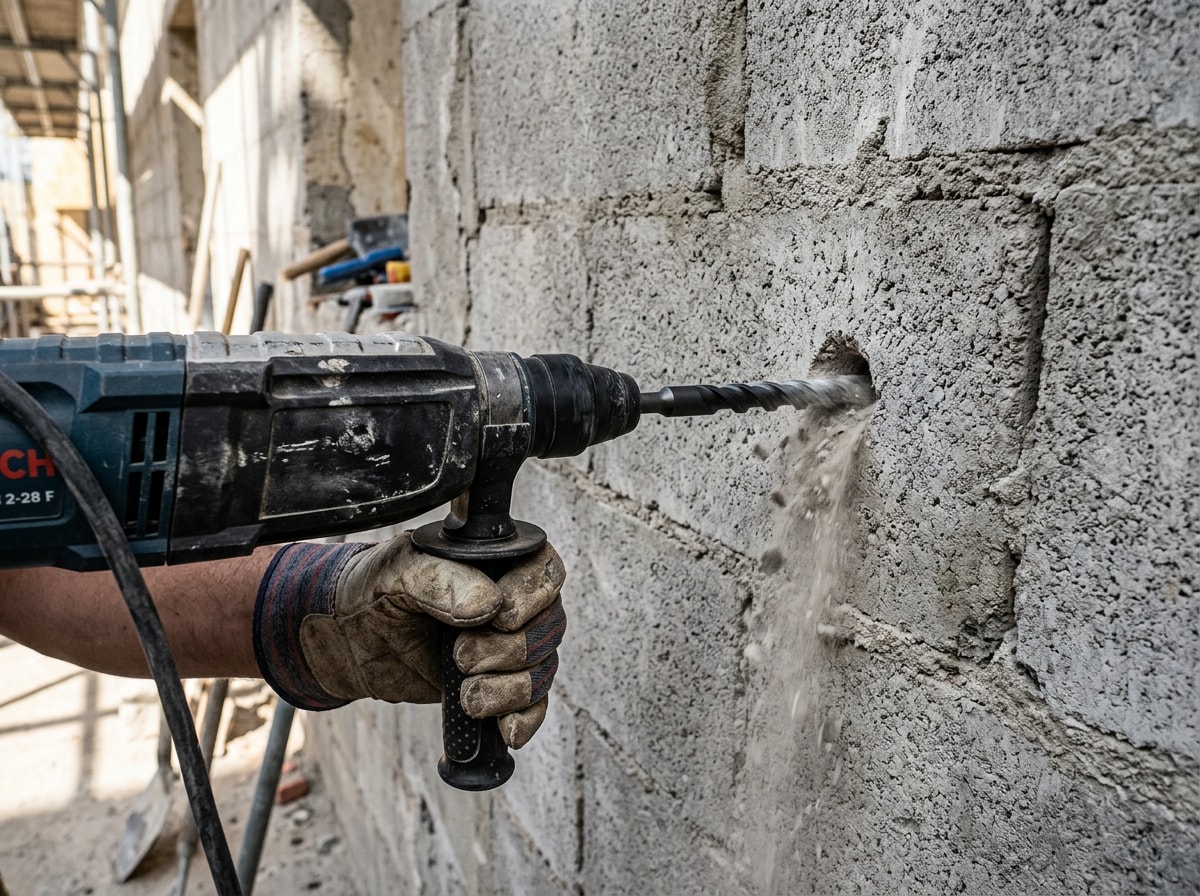
Hold the hammer drill perpendicular to the surface and drill straight to the marked depth. For the 3/16" and 1/4" diameter screws, the hole must be drilled a minimum of 1/4" deeper than the screw will penetrate , giving dust somewhere to settle instead of packing under the screw tip. An angled hole side-loads the screw once it's driven, which noticeably reduces holding capacity even if the screw technically fits.
Step 3: Clear the Hole of Dust
Clean out the hole of all debris before inserting the screw. Leftover dust acts like a cushion that keeps the threads from biting into solid material, so blow it out or vacuum it before moving on.
Step 4: Position the Fixture
Insert the pointed end of the concrete screw through the fixture and into the hole in the base material. Tapcon-style screws don't need a separate sleeve, so the fixture, screw, and hole line up in one pass.
Step 5: Drive the Screw
Drive the screw with an impact driver or drill set to a moderate speed, easing off once the head seats firmly against the surface. These screws are driven, not torqued — continuing to apply torque after the head is flush is a fast way to shear the screw or strip the threads you just cut.
Common Mistakes and How to Avoid Them
The three most common failure points are an incorrectly sized drill bit, a hole that wasn't cleaned of dust before driving, and over-torquing once the screw seats.
- Wrong bit size. Leads to either a loose fit or a cracked base material.
- Dust left in the hole. Cushions the screw tip so threads never fully engage.
- Over-torquing. Strips the threads the screw just cut, so the fastener backs out under load instead of holding.
Drilling masonry also generates fine dust. Handheld and stand-mounted drills used to drill holes in concrete or masonry can generate respirable crystalline silica dust, and when inhaled over time, the small particles can irreversibly damage the lungs. For anyone drilling more than a handful of holes, OSHA's fact sheet on controlling dust from handheld and stand-mounted drills outlines practical controls worth following even on a small residential job.
What the Code Actually Says About Load Ratings and Reinstalling Screws
Most buying guides treat concrete screws as endlessly removable. The evaluation reports that code officials actually reference say otherwise for load-rated connections. Tapcon+ screw anchors may be loosened by a maximum of one turn and retightened with a manual torque wrench or powered impact wrench to facilitate fixture attachment or realignment, but complete removal and reinstallation of the anchor is not allowed.
That distinction matters. For light-duty, decorative work — mounting trim, boxes, small brackets — backing a screw out and reinstalling it once or twice is common practice and usually fine. For anything a building official would actually check, like a structural bracket or a railing anchor, the governing evaluation report outlines specific strength design and allowable stress design parameters for the anchors , and reusing a hole outside those parameters can quietly undercut the rated capacity. If a connection matters structurally, treat the pilot hole as single-use and drill a fresh one rather than reusing the old threads.
If you'd rather not gamble on which category your project falls into, EMGE Paving and Roofing serves Carroll County, MD and handles everything from hardscape installation to full paving and roofing work where code-rated fastening actually matters. See completed jobs on our projects page or request a free estimate for your next one.
FAQ
Do self-tapping concrete screws need a pilot hole?
Yes. Despite the name, self-tapping screws still require a correctly sized pilot hole. The screw taps its own threads into that pre-drilled hole rather than drilling the hole itself.
What size drill bit do you need for self-tapping concrete screws?
For the 3/16 inch screw you need a 5/32 inch bit and for the 1/4 inch screw you need a 3/16 inch bit. Matching these exactly is critical for proper holding strength.
Do I need a hammer drill to install concrete screws?
Yes. A standard drill can't reliably cut into concrete or masonry. A hammer drill or rotary hammer delivers the percussive action needed for a clean pilot hole.
Can self-tapping concrete screws be removed and reinstalled?
For light-duty, non-structural work, generally yes — they can be backed out and reinstalled once or twice in the same hole, though repeated removal gradually wears the cut threads and reduces holding power. For code-rated structural connections, the manufacturer's evaluation report may prohibit full removal and reinstallation outright, so check the specific product's documentation before reusing a hole on anything load-bearing.
How much weight can a self-tapping concrete screw hold?
It depends on diameter, embedment depth, and the base material's compressive strength, so there's no single number that applies everywhere. Manufacturers publish exact allowable tension and shear values in their code evaluation reports for each diameter and substrate combination — check the specific report for your screw rather than relying on a generic figure.
What's the difference between self-tapping and self-drilling concrete screws?
Self-tapping screws cut threads into a hole you've already drilled. Self-drilling screws bore their own hole as they're driven, but that only works in thin materials like sheet metal — concrete is too dense for a screw to drill and thread in one motion, so concrete screws always need a separate pilot hole first.